

by Bob Marcks

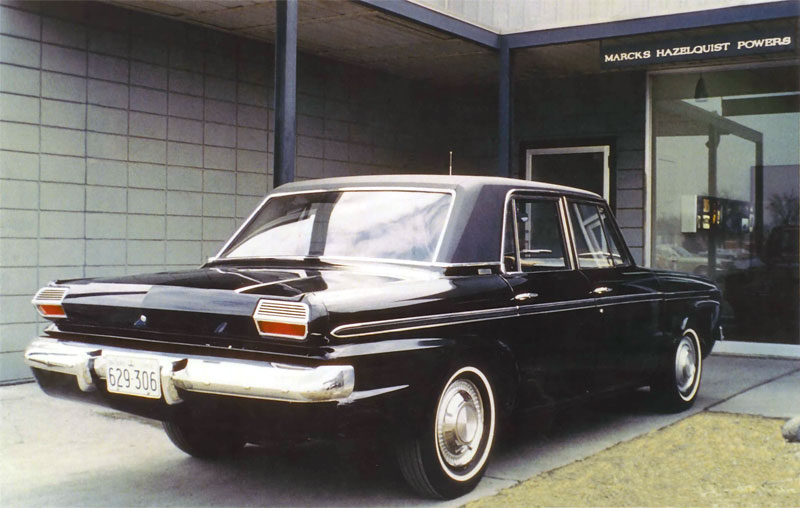
I was a staff designer with Raymond Loewy in 1953-54, and then my own firm produced the color and trim changes for the 1966 Studebaker and the 1967 prototype.
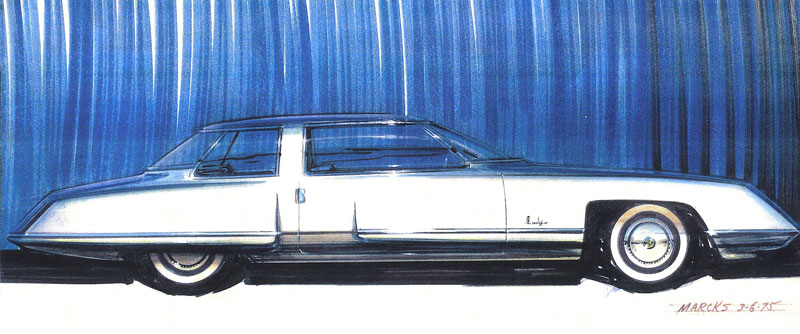
Our 1967 Studebaker prototype proposal is in front of the Marcks, Hazelqist, and Powers office in Dearborn, Michigan, along with drawings for future ’70 proposals. Marcks, Hazelqist, and Powers had a 1967 Studebaker prototype designed, and close to production. The last production car came off the line in March 1966, which was about the time this photo was taken. The Studebakers were necessarily tame because they were to be, at best, major facelifts of a pedestrian body of the period.
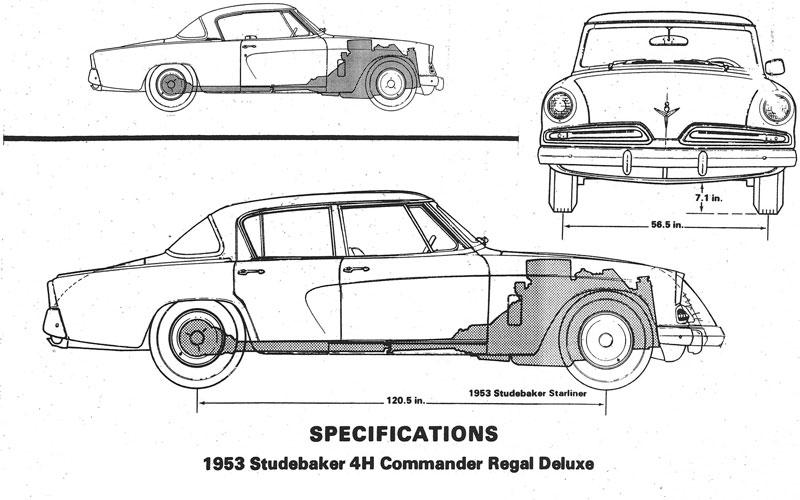
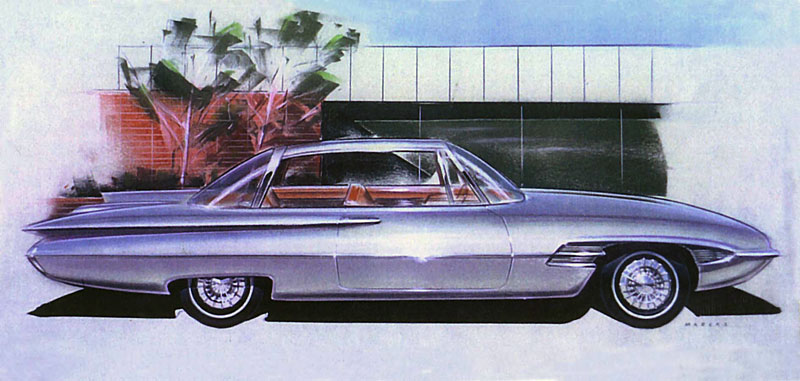
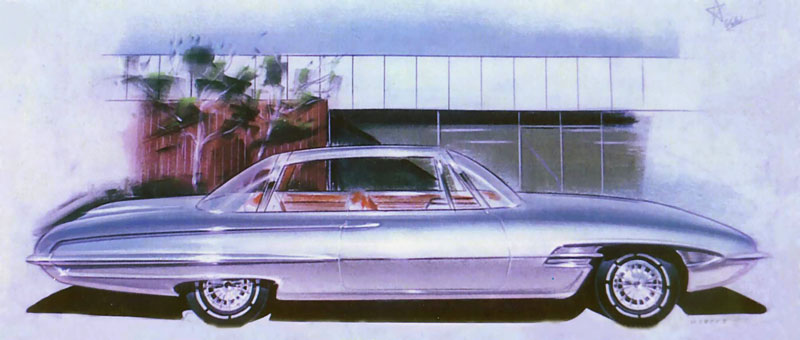
Studebaker never built a sedan which was based on the beautiful 1953 coupe. I was a designer there then and since then I have thought that they should have built such a sedan. Here is my scale line drawing of Starliner based sedan. This drawing was sent to Brazil along with several others which were developed into a 1/15th scale model.
When I had my own firm we designed (sadly) the last (1966) Studebaker, but were working on future possible Studebakers. In this case we were trying to work with an existing platform which included the windshield and doors, etc. That was a problem.
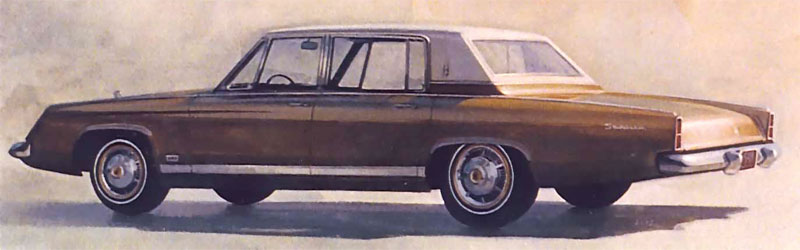

We actually created a more restrained version (we didn’t modify the roof) of this Lincoln with the filigree work as our company car. In Los Angeles it really did get favorable attention and envy from all the auto exhibitionists and even the hippies gave it a thumbs up. If anyone asked we told the the trim was silver from Tasco, Mexico. That illustration is in color and beautiful, by one of the staff guys.
I was a designer for Ford in 1953, and 1956-1961. Here are two of my Ford proposals, one is of a series for the 1964 Ford ’64 Galaxie, which I also designed. Another of my sketches provided the major inspiration for the ’64 T-Bird. The two Ford drawings I’m proud of because they were part of a series that became the ’64 Ford Galaxie, two years after I left Ford. You can see the beginnings of the rear quarter in one of the drawings. Regrettably, I don’t have the final Galaxie drawing.
Ford leaked this photo of a Thunderbird rendering to a magazine as a preview teaser (from fall 1963 Motorcade) for the ’64 T-Bird. As I recall, it was originally as a metallic red. I had left Ford in 1961 so it was very unusual for them to use a design that was from someone who had left. Ford had a total staff of 1,000 in the styling building, this just for designers, modelers, support, and a skeleton crew of engineers. The engineering department itself was somewhere else.
Here’s the Turbine Car as it turned out. It started life as the Chrysler LeBaron. I changed the whole front end, and refined some of the other elements in the rear quarter and back. The grille texture and “waterfall” was similar to the ’76 Imperial, to keep a Chrysler look. I didn’t know if there was a “right’ shape for a turbine engine grille, but I figured it ought to be different so I made it narrow. I like the center photo because it shows off the execution to best advantage. I supervised it “off-site” with non-union help on the modeling, so I could get involved myself. Unknown to me, the car was selected to be inspiration for the 1980 Imperial (If they liked it so much, how come I wasn’t invited to participate??). I thought the ’80 could have been a lot better, a little crown in the surfaces would have helped for openers.
The ad campaign for the Chrysler Cordoba, with Ricardo Montalban’s praise for its “fine Corinthian leather,” contributed greatly to its success (the company worried that the car was too small to be a Chrysler!) and it has been called “one of the five best automotive campaigns of all time.” At the time, in 1977, I was a Chrysler designer who had recently moved to Chrysler from California, where I had lived on the beach, at Sunset Boulevard and PCH-1 (Pacific Coast Highway One). So I was familiar with what the affluent residents of Malibu and Beverly Hills drove. With that in mind, I customized a Cordoba for Ricardo Montalban with the objective of making it a car he could really drive with pride in that elite environment.
I studied the classics of the ’30s and ’40s. I settled on an Art Deco-style black and silver motif, that is carried throughout. Gold accents turn up in the pin-striping, hood ornament and tire stripe. I designed custom seats that were trimmed in extremely soft Silver (belly) leather. The carpet is black mouton. The fake woodgrain trim was replaced with silver leather and brushed silver inserts on the instrument panel. I added a Maserati air horn—the “right” sound for Sunset and Wilshire Boulevard traffic. It had a remote starter that died early on. It has wire wheels and Vogue tires, found on classic cars of long ago, and half the Eldorados in Beverly Hills. After appearing at the Detroit and Chicago Auto Shows, it was sent to Ricardo Montalban for his use.
Shortly thereafter, I received a four page hand written letter from Ricardo in which he said, “My reaction to the prototype Cordoba is…I’m in love with it! It is, without a doubt, the handsomest car I’ve ever had. All my friends, parking boys, gas attendants, express their admiration. It is truly unique.” And the letter winds up with, “I congratulate you on the marvelous job you did on the car and please consider me your devoted fan (a little role reversal there!).”
It was his until the Cordoba model change two years later. At that point I acquired it for just $5,000, as my personalized dream car. It is now in the Chrysler museum in Auburn Hills, Michigan.
Nice website! I really enjoy seeing and reading about the ‘behind the scenes’ automotive design work that was done during the ’50s through the ’80s.
I also loved the article and photos regarding the customized Cordoba you developed for Ricardo Montalban. I remember the ad program very well and was always a fan of the Cordoba. In my view it was the nicest of the personal luxury cars that were in vogue at the time.At some point in the future it would also be great to see some photos of the interior of this particular car.
Thanks again for the great work on your website.
Nice website, sad day when Studebaker stopped building cars!
Denny Merritt
It’s amazing how often designs that are older are tweaked and presented as something new and Fresh. Take for instance that 1954 Studebaker profile. Way ahead of its time for the period. Well, here we are in 2012 and Nissan has built a crossover called the Juke and aside from oddly placed exterior lighting and an abrupt trunk the silhouette of the profile is the same. I’m glad that Bob Marcks contacted the New Studebaker Motor Company at http://www.studebakermotorcompany.com because it shows that the desire of American designers still favor American built vehicles. I work for the company and you can’t imagine how interjection from experts like Bob Marcks is appreciated.
Hi.Bob-As you remember your Turbin car was modeled, cast, fabricated, painted and trimed at Synthetex Inc. then located in Romulus, Michigan. Synthetex Inc. also painted and trimed the Cordoba for Ricardo Montalban under your supervision.
Ron Mondrush
Hello… As always, very interesting stuff. But… I must have missed something here since I cannot find any of the images referred to such as the ’64 Thunderbird or the Turbine LeBaron. Where are these images???
And yes, I remember Synthetex, Inc. As I recall they did the Dodge Challenger concept “Yellow Jacket” which I loved. Would love also to talk with Ron Mondrush…
What a nice surprise to see Ron Mondrush’s comments! It was pleasure working with you, Ron, on the Montalban Cordoba, and I had fun (hope you did too) in the process. The car was well received everywhere; the hypothetical customer became a reality when the car was loaned to Ricardo for several years, who was thoughtful enough to write me a letter in praise of the car. Later, I owned it, then it went to the Chrysler Museum, Current whereabouts unknown.
Any pictures of Khan’s, sorry, Ricardo’s, sorry again, YOUR Cordoba?
The Studebakers are very handsome, congratulations on that, I especially like the vinyl top car, and that’s a first for me, I believe.
Is it true that Studebaker forced all designs to recycle parts like glass, door handles etc.?
Again, great article. I still intend some day to own a GT Hawk 4-speed.
I have reread this post several times over the last few years. Still fascinating.