Days of Future Past

By Mel Francis

7979791902_9b4a8ea8f4_o

Below the photo is an attempt at an introductory article, if you see fit to add it to your site. I’d be really interested to see what comments might be contributed by retired GM designers who were around at that time.

While the iconic 1967 Moody Blues album of the same name was an outstanding concept in itself, its title expresses somewhat, the plight of many well known automotive concept vehicles, over the ensuing years. While all present a view of a future automotive product, in many cases that vision never comes to pass, for a multitude of economic and practical reasons and are left behind, merely as signposts along the main path of automotive development, pointing to an alternate path that could have been taken. GM’s discarded and long-forgotten 1955 Lasalle II concept vehicles are definitely of this variety. Their strength lies not in their exterior form, which was only average for that amazing breakout period of General Motors styling, but more for their basic package concept.

In the fall of 1954, GM’s designers were experimenting with the concept for a future car for America’s drivers that would be smaller than full-size and more like a European car.
For starters, they penned a more efficient, unitized platform with only 108″ wheelbase and lightweight suspension at all corners. With no frame members in the way, the seats could mount directly to the flat floor, giving the driver and passengers ample headroom, even with a low overall height of 50.5″. It would be powered by a front-mounted, almost unheard-of, for the time, SOHC Fuel Injected 60 degree V6 that used a step-down unit mounted on the front of the trans to turn a very low-slung driveshaft, for minimum tunnel intrusion. This mated to a fixed rear differential, with jointed axles connecting to De-Dion uprights, all mounted on semi-elliptic springs. This was at a time when production Corvettes were destined to use the same, heavy rear axle assembly as the full-size Chevrolets, for another 8 years!

Because this concept was first presented at the ’55 Motorama show during a period when the growing trend was growth itself, with family cars becoming longer, lower, wider, and festooned with chrome, glitz and tailfins, it soon languished behind the scenes, with other dead-end concepts, forgotten in storage. By late 1959, it had been relegated to the crusher, since it didn’t reflect any of the current trends that were creating profit for the Corporation and of course, Ed Cole’s rear-engined Corvair had been approved as a go-ahead for production.

But those famous Motorama shows of the mid- ’50s were attended by engineers and stylists from around the world and some of this concept’s basic specifications must have appealed to the designers of the ‘cars of the future’ at BMW. If you take a look under this concept, with its fully chromed suspension, you might recognize that you’re looking at essentially the chassis engineering of a more modern BMW. By the mid-’60s, their designs for family cars were the first to adapt their inline 6-cylinder engine, independent suspension with a fixed rear differential to their own, newly-developed unit-construction chassis.

If GM had been able to put this basic format into production by 1960, instead of the more controversial Corvair, it would still have had to survive the horsepower wars of the ’60s. But they would have already had a proven compact vehicle line in place, when the ’70s bore down on us all, with a need to create more efficient cars that could not only get mid-20 mpgs, but provide efficient handling, too.

Hindsight is always so clear, but this is why I think Joe Bortz was really on to someting, that day in 1989, when he was able to wrestle these prototypes from the muck of a Detroit junkyard, after 30 years of obscurity. These humble little cars pointed the way to a future that was simply passed over and by the time GM did employ the 60 degree V6 in a light chassis, FWD had taken over most of their product line. Not so with BMW, as they had long seen the full potential of the RWD layout and continue to use it, right up to this day.

Here are some shots of the underside of the LaSalle. That repair in the lower arm was caused by pulling with a hook from a tow-truck, since Joe says the wheels had sunk into the ground over the 30 years, to the point that the sills were touching the ground. The other side of the suspension is undamaged, but their first attempt with the hook tore out some fiberglass in the lower RH valence. Note the unusual wheel spindle arrangement, with ball joints and the completely flat floor.

The transmission is pretty small, sort of a mini-powerglide, but I’ve seen the engineering drawings for this and the details of the step-down drive, that allowed the mainshaft to run on its own center, with the driveshaft centerline about 3-4″ up from the floor. Not much room for any internal friction bands, though. The rust-out in the floor to the right was caused by the windshield being missing and rain entering through the dash area all those years.

Here’s where it gets interesting. The (wooden) gas tank is just above the fixed differential, ahead of the axle centerline, much better than putting it out back. There’s a big bracket at the rear, which holds the diff and one at the front of the short torque tube. No universal joints out to the wheel hubs, more like those old sliding twin-ball units like Chrysler used to put at the front of their driveshafts. The De-Dion tube is pretty evident here and reminds me of the setup used on the ’57 Corvette SS, with its fixed diff and inboard brakes. Pretty sporty stuff!

A closeup of the rear-mounted parking brake assembly, onto a vented disk, no less! No room for this up front—if they ever built a test mule with this layout and suspension parts, I’ll bet it handled pretty well! Anti-roll bars front and rear. At some point, someone has jacked the car right on the handbrake cable clevis. The parking brake disc turns with the rear axle, so there is a gearset in there. See what I mean about this being a really interesting front engined alternate to the Corvair? The road not taken, too bad. I had read that there were a group of engineers that were upset with Cole’s insistence on the rear engine setup. This was probably their project!

Posted in Car Design, Mel Francis, Motorama, People | Tagged , | 7 Comments

A Bill Mitchell Anecdote

By Sheldon Payne

In 1974 I traveled  to Elkhart Lake/Road America to take in the Can Am. I stayed at Siebkens Resort where the drivers and Mitchell’s entourage were staying. Several Design Staff show cars and custom bikes made the trip with him. The Ducati GT 750 is on the right.—Gary

During the years 1969 and 1975, I worked for GM’s Body Development Studio at Design Staff and used to build motorcycle models at home in the winter to satisfy my desire for the real thing. The ones I spent the most time on were exquisite 1:9 models of exotic European grand prix bikes, made by Provini of Italy. Often I’d put one on my tabourette because I enjoyed looking at them, even while working.
Continue reading

Posted in Bill Mitchell, Motorcycles, Stories | 5 Comments

1966 Oldsmobile Toronado Development

Dick Ruzzin’s Personal account of the development of the ’66 Tornado

Artwork by Dick Ruzzin

I was new and experiencing my first design program of note. It was all like magic, as sketches, words and imagination all converged on the project and influenced what was going on in the studio.

I clearly remember my participation and that of others in the room which follows. I was really impressed with the management as they discussed the abstract future of the design, even though it was incomplete. They apparently trusted that it could be developed into a solution for a project that we designers had no knowledge of.
Continue reading

Posted in Car Design, Dick Ruzzin, GM Design Staff | Tagged , , , , , , | 19 Comments

GM Designer Bill Michalak

By Bill Michalak

13
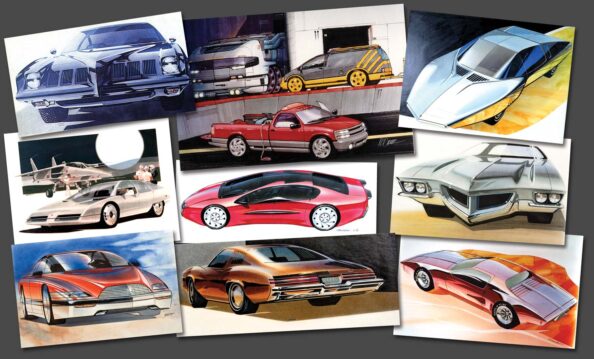
Concept rendering for 1973 Olds Cutlass. This brown rendering was done in marker and pastel.

My desire to design cars for General Motors started at the age of eight. Like many other kids with the same goal, I was fortunate to actually see my dream come true. Employment came by way of Chuck Jordan in 1966 during my last week at Pratt Institute in New York. During my 35 years at GM, retiring in 2001, I was in every studio accept Cadillac Production.
Continue reading

Posted in Bill Michalak, GM Design Staff, League of Retired Automotive Designers | 13 Comments